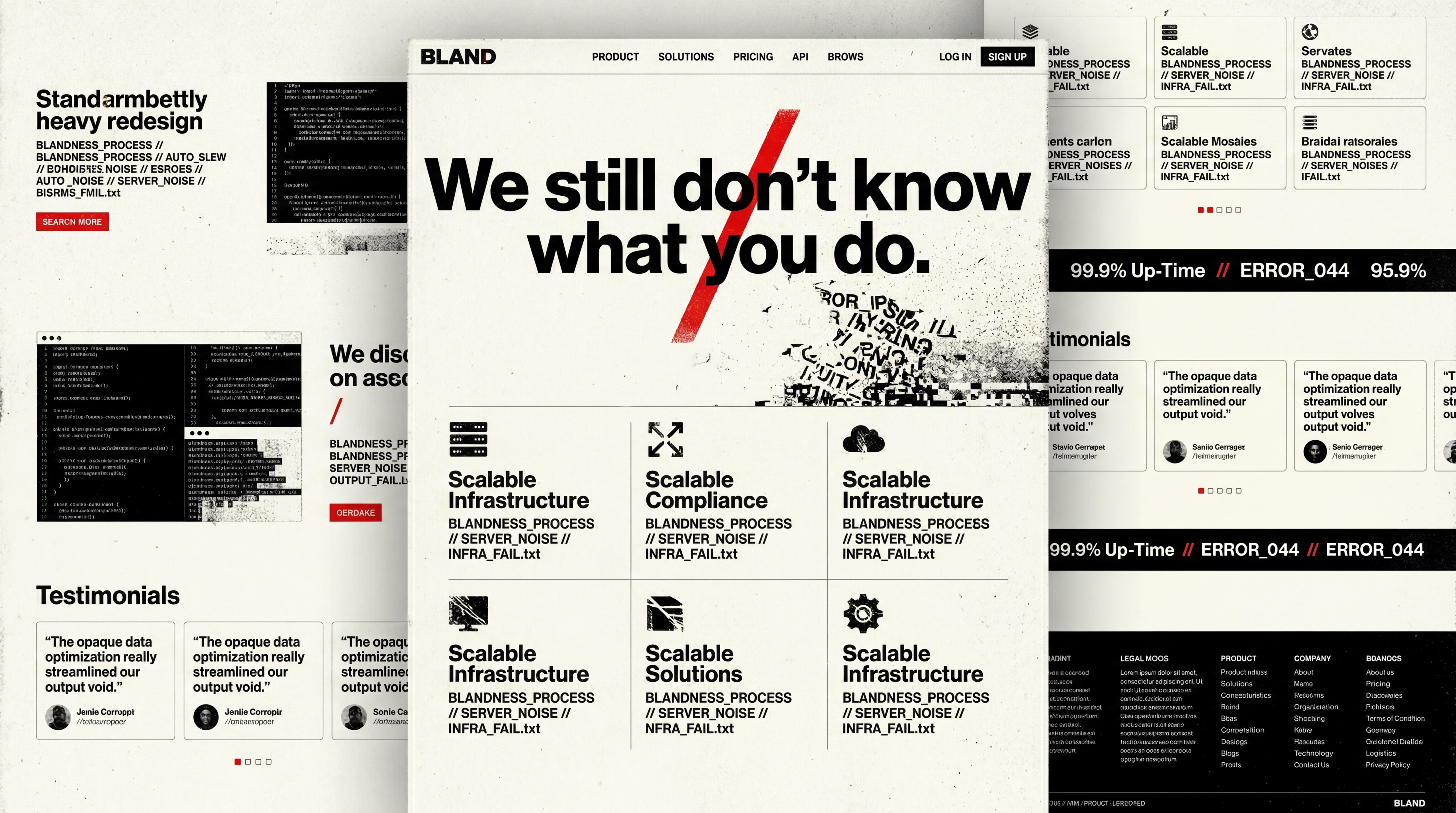
We spent four minutes on your website. We still have no idea what you do.
Your homepage has a full screen hero image, a bold headline, three paragraphs of carefully considered copy, and a button that says "Discover the Possibility." We clicked it. We read everything. We scrolled to the bottom where the small print lives. We checked the About page, the Services page, and whatever "Our Philosophy" means. We still cannot tell your wife what you do at dinner. And that is not her problem.
Posted at
Posted on
Content & Creative
Your Website Is a Vibe Board Pretending to Be a Business
Somewhere between the brand refresh and the copywriter who charged too much and delivered too little, the actual explanation of what you do got replaced with language that sounds important without meaning anything.
"We partner with forward-thinking organizations to architect transformative experiences that drive meaningful outcomes at the intersection of strategy and innovation."
Read that sentence again. Now read it one more time. Now ask yourself what product or service just got described. A consulting firm? A tech company? A particularly ambitious candle brand? The answer is yes. The answer is all of them. The answer is none of them. That sentence belongs to everyone and therefore to no one and it is currently living on approximately 40,000 websites right now doing absolutely nothing for any of them.
Your homepage is not a poem. It is not a mood. It is the first handshake you give every single person who is considering giving you money. And right now that handshake is limp, vague, and wearing too much cologne.
The Press Release Situation Is Somehow Worse
At least the website is trying to be interesting.
The press release is not trying to be anything except legally defensible. It was written by someone who has never had a conversation with another human being about why your company matters. It leads with the company name, the date, and a headline that could not possibly make anyone feel anything. It contains the phrase "pleased to announce." It has a quote from the CEO that the CEO did not write, did not say, and would not say if you put them in a room with a journalist and a deadline.
"We are thrilled to welcome this exciting new chapter as we continue to execute against our strategic vision of delivering best-in-class solutions to our valued partners and stakeholders."
Nobody said that. Nobody has ever said that. That quote was assembled from spare corporate parts by someone who was afraid of saying something real and chose the safety of saying nothing in the most words possible.
Here is what that press release needed to say:
What happened. Why it matters. Why now. Who cares.
Four things. That is the entire job. And somehow the press release managed to discuss none of them across six paragraphs and a boilerplate that reads like terms and conditions for a product nobody bought.
Clarity Is Not Dumbing It Down. It Is the Whole Job.
There is a belief — unspoken, persistent, deeply wrong — that sounding complicated signals credibility. That if you use enough sophisticated language, the reader will assume the thinking behind it is equally sophisticated. That clarity is somehow beneath a serious company.
Apple does not think this.
Stripe's entire homepage is "Financial infrastructure for the internet." Seven words. Billion dollar valuation. They did not feel the need to add "leveraging cutting-edge payment orchestration solutions to empower merchants across the digital commerce ecosystem." They said the thing. They moved on.
Mailchimp used to say "Send better email." Not "an intuitive marketing automation platform designed to help small businesses maximize engagement across digital channels." Send better email. Done. Come inside.
The brands that own their categories are almost always the ones who can explain what they do in one sentence that a person would actually say out loud to another person at a party. Not a LinkedIn post. Not a pitch deck. A sentence that comes out of a real human mouth in a real human conversation without anyone dying of embarrassment.
Can you say yours out loud without cringing?
How to Actually Fix It
Find someone in your company who is not a founder, not a marketer, and not emotionally invested in the current website copy. Show them your homepage. Ask them to explain back to you what your company does.
What they say is your new homepage copy.
Not polished. Not yet. But that confused, slightly generous, genuinely trying summary of what they understood? That is closer to the truth than anything your current hero section is delivering. Because that person is your customer. And if they cannot figure it out in thirty seconds, your customer cannot either and your customer has already clicked away to someone who told them plainly.
Then take your last press release and do this: delete every sentence that could not be said out loud by a real person in a real conversation. Delete "pleased to announce." Delete "best-in-class." Delete the CEO quote that the CEO did not write. Delete the boilerplate. Delete "valued partners and stakeholders."
What is left is the press release you should have sent.
It will be shorter. It will be scarier. It will actually work.
The Signal
Clarity is not a writing style — it is a business decision. Every vague headline, every lawyer-approved press release, every homepage that sounds impressive and explains nothing is a prospect who bounced, a journalist who passed, a partner who went with someone they actually understood. Say the thing. Say it plainly. Say it like a human being who is proud of what they built and confident enough to just tell you what it is. The brands that win do not hide behind language. They lead with it.