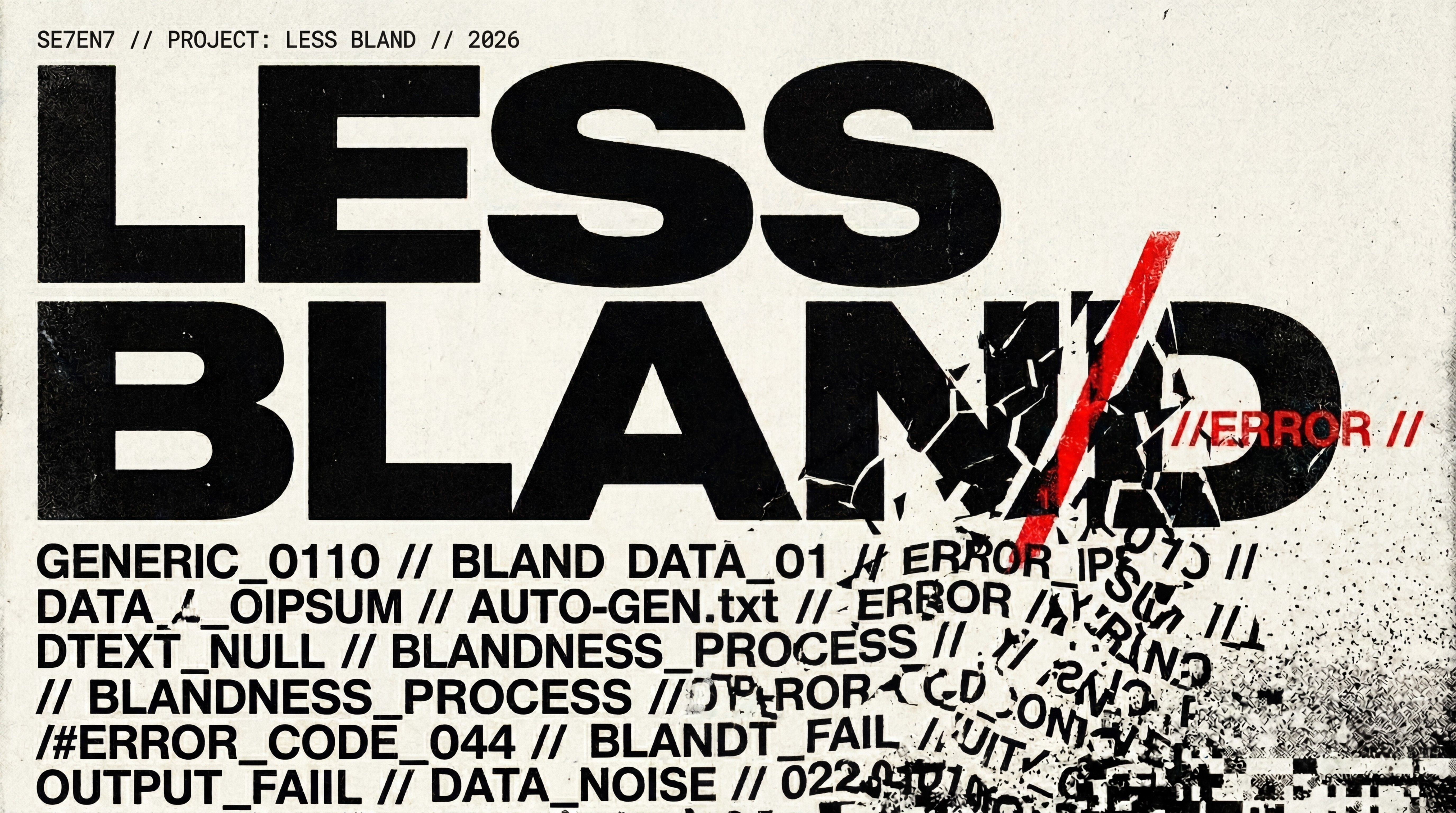
The logo is gorgeous. The positioning is in witness protection.
Somewhere right now a founder is staring at their brand new website and it is stunning. The typography is perfect. The color palette is sophisticated without trying too hard. The logo mark took three agencies, two arguments, and one near-resignation to land on — and honestly? Worth it.
Posted at
Posted on
Brand Identity
The launch post got 400 likes.
A former colleague DMed to say it was "very on-brand," which felt deeply meaningful even though that colleague has absolutely no idea what the brand is.
Neither does the market.
But the logo! Incredible.
You Didn't Rebrand. You Got a Really Expensive Haircut.
Here is the thing nobody says at the rebrand celebration dinner.
Most rebrands are redesigns wearing a trench coat. And it works for a while because novelty has its own gravity. The new site launches. Leads tick up. The sales team walks into pitches with actual confidence because the deck no longer looks like it was assembled in 2014 by someone who thought drop shadows were a personality.
Everything feels different.
Then six months pass.
Same deals stalling at the same point. Same prospects nodding politely and saying they need to "think it over," which is prospect-speak for "I still don't understand why you and not someone else."
And the gorgeous new logo just sits there on the pitch deck.
Looking incredible.
Completely unable to help.
Because logos do not answer questions. Positioning does. And yours is currently living under an assumed name in Albuquerque, not taking calls, definitely not showing up to pitches.
What You Actually Paid For
Redesigns have finish lines.
A launch date. A brand guidelines PDF nobody fully reads. A Figma handoff. A LinkedIn before-and-after that gets reshared by seventeen designers and your college roommate who is "really proud of you."
There is a moment where someone hits publish and the thing is done and everyone goes to dinner and it feels great.
Positioning does not have that moment.
It has a direction. Hard choices. A meeting where your leadership team has to agree on who you are NOT for — which is one of the most uncomfortable conversations ambitious people can have because every instinct in the room says yes we could work with them too, why would we turn away revenue.
Real positioning closes doors on purpose.
It says something specific enough that someone disagrees with it.
It picks a lane and stays there even when a shinier lane shows up three months later waving money.
None of that fits in a project scope. None of it comes with a logo file at the end.
So most companies skip it and pay for the part that does have a deliverable. The launch video. The ambient music that swells as the new logo reveals itself like it just won something.
And the positioning question gets answered in a brand workshop with a whiteboard, a Venn diagram, and four adjectives that could apply to literally any company on earth.
Bold. Innovative. Human. Forward-thinking.
Stunning. You've just described a refrigerator.
The Brands That Got It Right Started Somewhere Else Entirely
Old Spice did not save themselves by finding a better font.
They looked at an entire category of safe, beige, aggressively inoffensive deodorant marketing and made one deliberate decision: be the opposite of all of it. Completely. Without apology. The horse. The man. The impossibly fast wardrobe changes. All of that was execution. The strategy underneath was simple — own the thing nobody else will touch and hold it with both hands.
Burberry did not climb out of their mid-2000s identity crisis because they commissioned a prettier logo. They made a real decision about who they were for and what the brand was allowed to stand for. The visual identity followed that decision. It expressed it.
It did not create it.
Here is the thing people get backwards every single time.
The visual identity is the proof. The positioning is the argument. And you cannot win a case by showing up with beautiful slides and nothing to say.
The Only Question That Actually Matters
Before the moodboard. Before the naming sprint. Before anyone opens a color palette or starts arguing about fonts like it is a personality trait — answer one question.
What do we need people to believe about us that they don't currently believe?
Not we need to feel more premium.
Not we need to look more modern.
Those are aesthetics wearing a strategy costume and they are not fooling anyone.
The real answer is specific. Uncomfortable. True.
Maybe your buyers see you as a vendor and you need them to see you as the only call worth making when things get hard.
Maybe you built something for an entire category but the market still thinks you are a one-product company.
Maybe your competitor owns safe and you are going after sharp and you are done apologizing for it.
That sentence is the work.
That is positioning.
Everything else — the logo, the site, the campaign, the way your team introduces themselves at a conference, the font you argued about for three weeks — all of it is execution.
Get the sentence right and the identity has something to say.
Get it wrong and you have spent a lot of money making your confusion look absolutely incredible.
And your confusion, it must be said, has excellent taste in typography.
The Signal
A rebrand without a positioning shift is just a very photogenic problem. You'll get the compliments, you'll get the likes, and you'll get the exact same results in a much more attractive package. Figure out what you need the market to believe before you touch a single pixel. Make it specific enough to close doors. Make it true enough to sting a little. Then make it gorgeous. In that order. Always in that order.